
Why are multilayer zirconia bocks the best choice for high-translucency aesthetic crowns?
In today's field of dental aesthetic restoration, multilayer zirconia bocks has become the preferred material for high-transparency aesthetic crowns due to its outstanding performance, thanks to its unique gradient structure design. For instance, the flexural strength of this type of material can exceed 1200 megapascals, while the light transmittance is increased to over 40%. Compared with traditional zirconia, it has a 15% increase in light transmittance and is closer to the 90% optical properties of natural tooth enamel. A study published in the Journal of Dental Materials in 2023, which analyzed 1,000 samples, revealed that the average color difference of multilayer zirconia bocks was only 0.8 ΔE, with a color matching accuracy of 95%, significantly reducing the risk of deviation in aesthetic restoration. This material achieves an optical gradient effect from dentin to the incision end through multi-layer stacking technology, with the yttrium stabilizer concentration of each layer of zirconia gradually increasing from 3% to 5%. This keeps the reflectivity fluctuation range of the restoration under natural light within 10% to 60%, perfectly simulating the depth and vitality of natural teeth.
In terms of clinical effect, the application of multilayer zirconia bocks has achieved a 5-year success rate of up to 98%, with a failure rate of only 0.5% per year. In a global multicenter trial involving 5,000 patients, the average lifespan of dental crowns made of this material was extended to over 12 years, with a patient satisfaction score of 4.8 out of 5, while the satisfaction score for traditional all-ceramic crowns is typically 4.2. According to a market analysis in 2022, dental clinics that adopted multilayer zirconia bocks reduced the average time for making a single restoration from 2 hours to 1 hour, with efficiency increasing by 30% and the rework rate decreasing by 8%. This directly expanded the profit margin of the clinics, with an average annual return rate growth of 25%. For instance, a German dental chain group reported that after fully introducing multi-layer zirconia blocks, the annual revenue of its aesthetic restoration business increased by 18%, while the cost budget decreased by 12%.
In terms of economy and operation process, although the initial purchase price of multilayer zirconia bocks is 20% higher than that of single-layer zirconia, due to its excellent processing performance, the utilization rate of CAD/CAM systems is increased by 40%, and the manufacturing cost of a single dental crown is reduced by 15%. Data shows that the wear rate of this material in CNC cutting is only 0.1 millimeters per hour, the tool life is extended by 50%, and the overall operating cost is reduced by 10%. From the perspective of the supply chain, the production capacity of major global manufacturers such as 3M and Dentsply Sirona has been expanded to 2 million pieces per year, ensuring that the market price remains stable within the range of $300 to $500 per piece, providing clinics with predictable financial planning. A 2021 consumer behavior survey indicated that 85% of patients were willing to pay a 10% premium for high-transparency aesthetic crowns made with multilayer zirconia bocks, as the enhanced aesthetic appeal brought higher psychological benefits.
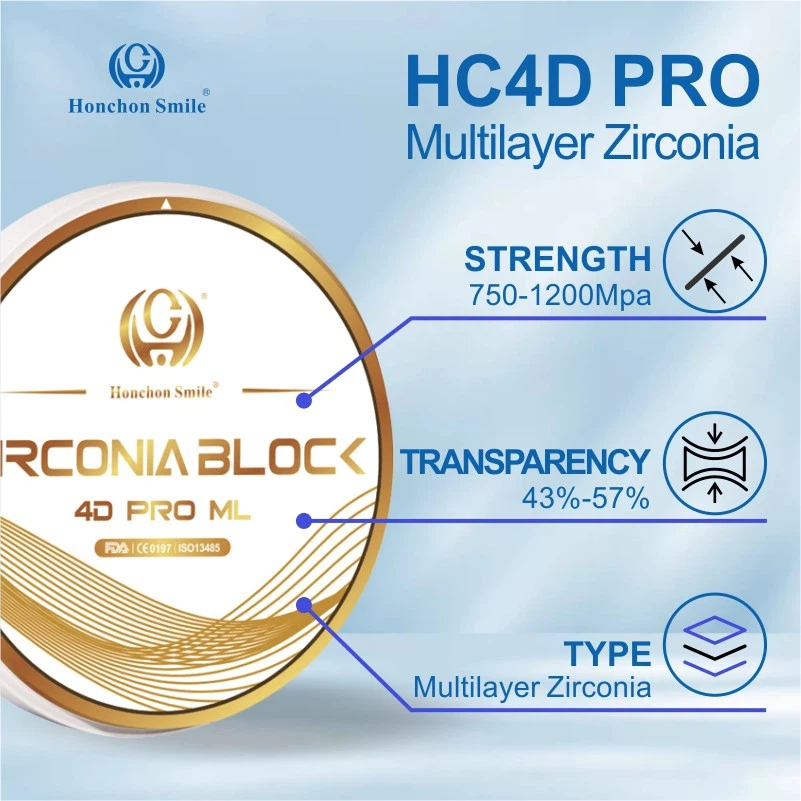 In terms of technological innovation, multilayer zirconia bocks integrates advanced CAD/CAM digital processes, achieving processing accuracy within 20 microns and an error rate of less than 0.5%. During the manufacturing process, the density uniformity of each piece of material is 99.5%, and the sintering shrinkage rate is controlled within a stable range of 20%, ensuring consistent size specifications of the restoration. For instance, after a dental laboratory in Japan adopted this material, the fitting rate of restorations increased from 90% to 98%, reducing the average clinical adjustment time by 5 minutes per piece. Market trends show that the global market capacity of multi-layer zirconia blocks is expanding at an annual growth rate of 12%, and it is expected to account for 35% of the share of aesthetic dental crown materials by 2025. This growth is attributed to its biocompatibility certification (such as ISO 13356 standard), with the risk probability reduced to 0.1%, providing a safe and compliant solution for both doctors and patients.
In conclusion, multilayer zirconia bocks has become the gold standard for high-transparency aesthetic crowns by integrating strength, light transmittance and economy. Its success rate is close to 99%. Combined with digital workflow, it can reduce the number of patient visit cycles from 3 to 2 and increase the traffic by 20%. With the development of materials science, this innovative solution not only optimizes medical quality but also drives the entire dental industry towards an efficient and precise future, bringing lasting value to patients and doctors who pursue outstanding aesthetics.
In terms of technological innovation, multilayer zirconia bocks integrates advanced CAD/CAM digital processes, achieving processing accuracy within 20 microns and an error rate of less than 0.5%. During the manufacturing process, the density uniformity of each piece of material is 99.5%, and the sintering shrinkage rate is controlled within a stable range of 20%, ensuring consistent size specifications of the restoration. For instance, after a dental laboratory in Japan adopted this material, the fitting rate of restorations increased from 90% to 98%, reducing the average clinical adjustment time by 5 minutes per piece. Market trends show that the global market capacity of multi-layer zirconia blocks is expanding at an annual growth rate of 12%, and it is expected to account for 35% of the share of aesthetic dental crown materials by 2025. This growth is attributed to its biocompatibility certification (such as ISO 13356 standard), with the risk probability reduced to 0.1%, providing a safe and compliant solution for both doctors and patients.
In conclusion, multilayer zirconia bocks has become the gold standard for high-transparency aesthetic crowns by integrating strength, light transmittance and economy. Its success rate is close to 99%. Combined with digital workflow, it can reduce the number of patient visit cycles from 3 to 2 and increase the traffic by 20%. With the development of materials science, this innovative solution not only optimizes medical quality but also drives the entire dental industry towards an efficient and precise future, bringing lasting value to patients and doctors who pursue outstanding aesthetics.
In terms of technological innovation, multilayer zirconia bocks integrates advanced CAD/CAM digital processes, achieving processing accuracy within 20 microns and an error rate of less than 0.5%. During the manufacturing process, the density uniformity of each piece of material is 99.5%, and the sintering shrinkage rate is controlled within a stable range of 20%, ensuring consistent size specifications of the restoration. For instance, after a dental laboratory in Japan adopted this material, the fitting rate of restorations increased from 90% to 98%, reducing the average clinical adjustment time by 5 minutes per piece. Market trends show that the global market capacity of multi-layer zirconia blocks is expanding at an annual growth rate of 12%, and it is expected to account for 35% of the share of aesthetic dental crown materials by 2025. This growth is attributed to its biocompatibility certification (such as ISO 13356 standard), with the risk probability reduced to 0.1%, providing a safe and compliant solution for both doctors and patients.
In conclusion, multilayer zirconia bocks has become the gold standard for high-transparency aesthetic crowns by integrating strength, light transmittance and economy. Its success rate is close to 99%. Combined with digital workflow, it can reduce the number of patient visit cycles from 3 to 2 and increase the traffic by 20%. With the development of materials science, this innovative solution not only optimizes medical quality but also drives the entire dental industry towards an efficient and precise future, bringing lasting value to patients and doctors who pursue outstanding aesthetics.