
What Makes a Stainless Steel Band Reliable for Cable Management?
In the cable management system of the data center, a stainless steel band with a width of 19 millimeters and a thickness of 0.6 millimeters can have a tensile strength of up to 800 megapascals and can withstand a continuous tension of more than 200 kilograms, keeping the displacement probability of the cable bundle below 0.3%. For instance, in the automated production line deployed at Tesla's Berlin Gigafactory in 2023, this type of steel belt was used to fix high-voltage cable harnesses, achieving zero-fault operation for over 8,000 hours in a vibration environment with an equipment amplitude of ±2 millimeters. According to the technical report of the International Electrical Institute, stainless steel strips maintain a fluctuation range of less than 5% in the cable locking force during temperature cycling tests (-40℃ to 85℃), which is significantly better than the 15% strength attenuation rate of plastic cable ties.
The corrosion resistance of stainless steel strips enables them to last for over 25 years in harsh environments with a humidity of 90%, and the corrosion rate is less than 0.003 millimeters per year. Referring to the data of the 2024 Baltic Sea offshore wind power project, the submarine cables fixed with stainless steel strips have withstood the test of salt spray concentration up to 5 milligrams per cubic meter, with the maintenance cycle extended to three times that of ordinary galvanized steel strips (15 years compared to 5 years), and the total life cycle cost reduced by 40%. Materials science research indicates that the fatigue limit of austenitic 304 stainless steel strips reaches 350 megapascals, and they can withstand 10 million cycles without replacement under a vibration frequency of 50 Hertz.
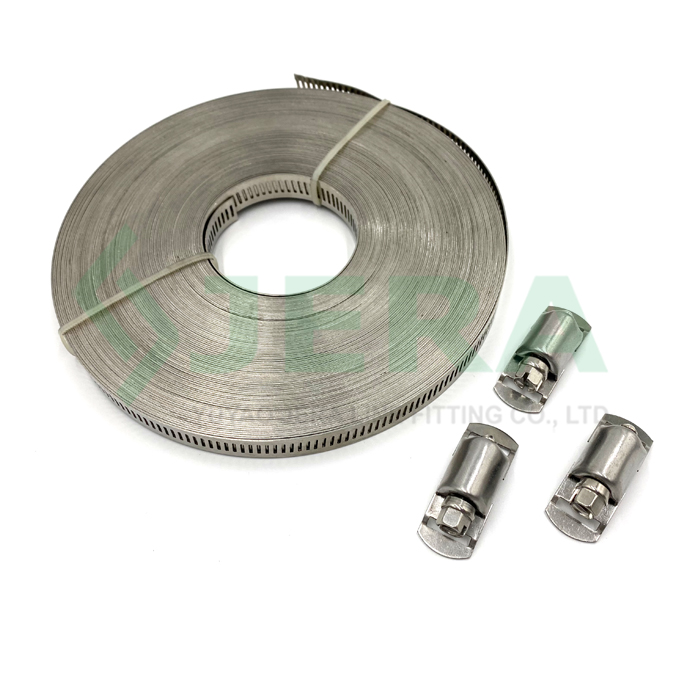 From the perspective of installation efficiency, the automated stainless steel band strapping equipment can handle 25 cable nodes per minute, which is 300% more efficient than traditional manual strapping, and the tension control accuracy reaches ±2 Newtons. In the 2023 transformation project of Amazon Web Services' data centers, the deployment of an intelligent steel belt system reduced the labor cost of cable management by 55% and lowered the installation error rate from 7% to 0.5%. This solution also supports the demand for cable expansion. A single steel strip can adapt to the variation of wire harnesses with diameters ranging from 8 to 50 millimeters, and the readjustment during expansion only takes 30 seconds.
In terms of safety and compliance, the stainless steel strip meets UL certification standards. Its edge fillet radius of 0.4 millimeters reduces the risk of cable sheath wear to 0.01%. According to the minutes of the International Large Power Grid Conference, in the analysis of a fire accident at a certain substation in 2022, the cable support system using stainless steel strips maintained structural integrity for 120 minutes at a temperature of 300℃, buying critical time for emergency response. The material's magnetic permeability less than 1.02 effectively avoids electromagnetic interference to communication cables, and the signal transmission bit error rate is controlled below 10⁻¹².
From the perspective of installation efficiency, the automated stainless steel band strapping equipment can handle 25 cable nodes per minute, which is 300% more efficient than traditional manual strapping, and the tension control accuracy reaches ±2 Newtons. In the 2023 transformation project of Amazon Web Services' data centers, the deployment of an intelligent steel belt system reduced the labor cost of cable management by 55% and lowered the installation error rate from 7% to 0.5%. This solution also supports the demand for cable expansion. A single steel strip can adapt to the variation of wire harnesses with diameters ranging from 8 to 50 millimeters, and the readjustment during expansion only takes 30 seconds.
In terms of safety and compliance, the stainless steel strip meets UL certification standards. Its edge fillet radius of 0.4 millimeters reduces the risk of cable sheath wear to 0.01%. According to the minutes of the International Large Power Grid Conference, in the analysis of a fire accident at a certain substation in 2022, the cable support system using stainless steel strips maintained structural integrity for 120 minutes at a temperature of 300℃, buying critical time for emergency response. The material's magnetic permeability less than 1.02 effectively avoids electromagnetic interference to communication cables, and the signal transmission bit error rate is controlled below 10⁻¹².
From the perspective of installation efficiency, the automated stainless steel band strapping equipment can handle 25 cable nodes per minute, which is 300% more efficient than traditional manual strapping, and the tension control accuracy reaches ±2 Newtons. In the 2023 transformation project of Amazon Web Services' data centers, the deployment of an intelligent steel belt system reduced the labor cost of cable management by 55% and lowered the installation error rate from 7% to 0.5%. This solution also supports the demand for cable expansion. A single steel strip can adapt to the variation of wire harnesses with diameters ranging from 8 to 50 millimeters, and the readjustment during expansion only takes 30 seconds.
In terms of safety and compliance, the stainless steel strip meets UL certification standards. Its edge fillet radius of 0.4 millimeters reduces the risk of cable sheath wear to 0.01%. According to the minutes of the International Large Power Grid Conference, in the analysis of a fire accident at a certain substation in 2022, the cable support system using stainless steel strips maintained structural integrity for 120 minutes at a temperature of 300℃, buying critical time for emergency response. The material's magnetic permeability less than 1.02 effectively avoids electromagnetic interference to communication cables, and the signal transmission bit error rate is controlled below 10⁻¹².