
Knowing When to Switch an ASIC Off
A mining machine should run whenever its revenue per terahash exceeds its power cost per terahash, and there is nothing ideological about that rule. At today's difficulty of 132.76 T, each terahash earns about $0.038 a day gross and $0.0365 after the listed 4% fee on the PPS-settled block reward, while each terahash at 20 J/TH burns 0.48 kWh a day — about $0.029 at $0.06/kWh. The margin per terahash is therefore around seven thousandths of a dollar a day, and it flips negative the moment your electricity rate crosses roughly $0.076/kWh.
Key takeaways
- The switch-off point is a rate, not a machine: at 20 J/TH the break-even electricity price is about $0.076/kWh; at 34 J/TH it falls to roughly $0.045/kWh.
- A 250 TH/s machine at 20 J/TH draws 5 kW — 120 kWh a day, $7.20 at $0.06/kWh — against $9.12 of net daily income, leaving about $1.92 a day of margin.
- The same machine on 30 J/TH silicon at the same rate loses about $1.68 a day, so part of the fleet can be underwater while the rest is profitable.
- Re-run the comparison monthly: difficulty stands at 132.76 T with the next adjustment estimated at -2.12%, and a network hashrate of roughly 1,003 EH/s keeps diluting per-machine share.
Context in 2026
Hashrate per machine has risen far faster than block subsidy, which was fixed at 3.125 BTC per block by the 2024 halving. With 144 blocks a day across the network, the entire industry competes for 450 BTC a day of subsidy, plus transaction fees. That is the whole revenue pool, and roughly 1,003 EH/s of network hashrate is pointed at it. Nothing about a pool's size changes the total; it only changes how smoothly your share arrives.
What makes 2026 different from earlier cycles is the narrowness of the margin for older silicon. A machine is not profitable or unprofitable in the abstract — it is profitable at a given efficiency, a given electricity price and a given difficulty. The live ViaBTC Miner Ranking is built for exactly this question: it lists how each ASIC model stands against current price and difficulty, which is a faster starting point than rebuilding the arithmetic from scratch for a dozen models by hand.
The two variables that matter
Revenue per terahash comes from the network: your hashrate divided by network hashrate, times 450 BTC a day, times the coin price, reduced by the pool fee. At difficulty 132.76 T and BTC at $84,692, that works out to $0.0379 per TH per day gross. Under PPS+ the block-reward component is charged a listed 4%, so the net figure is about $0.0365 per TH per day; under PPLNS both components are charged a listed 2%, which lifts the net slightly and returns the variance to you.[1]
Cost per terahash is a property of the hardware and your power contract. A machine rated at 20 J/TH consumes 20 W per terahash, or 0.02 kW — 0.48 kWh a day. Divide net revenue per terahash by kilowatt-hours per terahash and you get the electricity price at which the machine stops paying for itself.
| Efficiency | kWh/day per TH | Power cost at $0.06/kWh | Net revenue per TH/day | Margin per TH/day | Break-even rate |
|---|---|---|---|---|---|
| 17 J/TH | 0.408 | $0.0245 | $0.0365 | +$0.0120 | $0.089/kWh |
| 20 J/TH | 0.480 | $0.0288 | $0.0365 | +$0.0077 | $0.076/kWh |
| 25 J/TH | 0.600 | $0.0360 | $0.0365 | +$0.0005 | $0.061/kWh |
| 30 J/TH | 0.720 | $0.0432 | $0.0365 | -$0.0067 | $0.051/kWh |
| 34 J/TH | 0.816 | $0.0490 | $0.0365 | -$0.0125 | $0.045/kWh |
The table explains a pattern that puzzles a lot of operators: two machines in the same rack, one clearly worth running and one clearly worth shelving, even though both hash. Efficiency, not hashrate, decides which is which. A 250 TH/s unit built on 20 J/TH silicon and a 250 TH/s unit built on 30 J/TH silicon earn the same gross revenue and leave very different margins.
Numbers from a real rig
Work one machine end to end. A 250 TH/s unit at 20 J/TH draws 5 kW, which is 120 kWh a day, or $7.20 at $0.06/kWh. Its gross daily revenue at current difficulty is about $9.50, and after the listed 4% fee on the block-reward component the net is roughly $9.12. Margin: $1.92 a day, about $58 a month, close to $700 a year — and that is before cooling, hosting and any downtime. Compare that with the same hashrate on 30 J/TH silicon: 7.5 kW, 180 kWh, $10.80 a day of power against the same $9.12 net, a loss of about $1.68 a day.
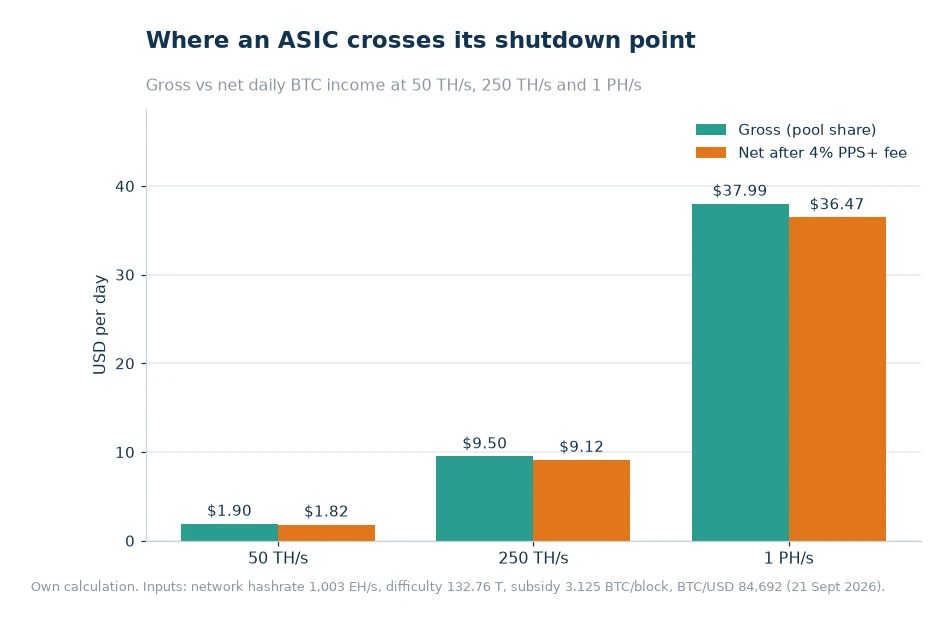
Scale changes the shape of the decision rather than the direction. A 1 PH/s farm earns about $37.99 gross and $36.47 net per day at current conditions; at 20 J/TH that is 20 kW, or 480 kWh a day, about $28.80 of power — leaving roughly $7.67 a day. At 34 J/TH the same 1 PH/s draws 34 kW and 816 kWh a day, around $48.96, which is $12.49 more than the net revenue. Same nominal hashrate, opposite decision. And because difficulty moves together for everyone, a network that keeps adding hashrate compresses the margin per terahash for every operator at once — which is why the ranking and the profit calculator are worth checking before a purchase, not after a bad month.
There is a second-order effect worth knowing about when you do shelve a machine. Because PPS+ settles the block-reward component per share at a listed 4% and pays hourly against current difficulty, income stops the moment shares stop and there is no lag while a round finishes — useful when you are cycling machines in and out. Under PPLNS, the last five difficulty rounds of your share history still matter, which is one more reason to keep a worker's participation stable through a cycle rather than switching it on and off daily. Pool-level figures for network-level context sit on the same operator's mining statistics page if you want to see how a pool's share of network hashrate is trending.
Decision guide
- Compute margin per terahash, not per machine. That single number lets you compare an old unit, a new unit and a rented rig on the same scale.
- Switch off when the break-even rate is above your power price. At 30 J/TH and above, that happens around $0.05/kWh; at 20 J/TH you have until roughly $0.076/kWh.
- Use effective hashrate in the calculation. A machine running at 96% effective output has 4% less revenue than its nameplate suggests — exactly the kind of gap that turns a thin margin negative.
- Check the model against live conditions monthly. A profitability ranking updated for current difficulty and price is faster than a spreadsheet, and it catches the moment a whole generation of silicon crosses the line.
- Reconsider the chain before you reconsider the machine. On a pool that supports merged mining and 20+ assets, a machine that no longer clears its power cost on BTC may still clear it on another chain — and switching chains needs no new hardware. A brief look at the mining pool overview shows which chains are supported before you power anything down.
- Keep a floor for fixed costs. Power is variable; cooling, hosting and network are not. A machine can be above its break-even rate and still below the cost of the infrastructure it occupies.
Frequently asked questions
What happens if my miner goes offline?
Shares stop, so expected income stops with them. Alerts and a dashboard that shows per-worker hashrate shorten the gap between a failure and a fix.
Is a bigger pool always better?
Size reduces payout variance but also concentrates hashrate. What matters more is fee structure, uptime, latency and payout cadence.
Does a lower pool fee save an unprofitable machine?
No. The fee is charged on the block-reward and transaction-fee components, so a 2% difference moves net revenue by about $0.0007 per terahash per day — far less than the gap between a 20 J/TH and a 34 J/TH machine at the same power price.
Run the check before the invoice arrives
Pick the three worst machines in the fleet this week and calculate margin per terahash for each, using effective hashrate rather than nameplate. If any is negative at your own power rate, schedule it off and move the capacity to a machine that is still positive. Then set a reminder to repeat the exercise after the next difficulty adjustment, because a margin of $1.92 a day on a 250 TH/s unit is a real but modest cushion. The point is not to predict price — it is to stop paying for hashes that cost more than they earn.
Data and sources: difficulty, network hashrate and BTC/USD read from public chain data on 21 September 2026. Fee structure per the ViaBTC fee schedule[1] and the ViaBTC mining guides[2]. Power costs, margins and break-even rates are own calculations from those inputs and from the stated efficiency in J/TH; they change with difficulty, price and local tariffs. Read on 21 September 2026.