
Is a high-output Fuel Pump worth it?
The core return on investing in high-flow fuel pumps lies in ensuring that the power system operates as designed. For engine upgrades with a target power of over 400HP, the original Fuel Pump can usually only support up to around 350HP. When the limit is exceeded, the measured fuel rail pressure will drop sharply by more than 15%, causing the air-fuel ratio to deviate from the target value of 12.5:1 by ±1.5, triggering the ECU's protective ignition chamfering, and the power loss can reach 8-10%. Data from the 2023 SEMA Modification Show shows that after replacing the original pump of the Focus RS (rated 270LPH) with the AEM 340LPH pump, in the 2.3T engine upgrade to 450HP plan, the measured pressure stability across the entire speed range was improved to within ±3%, avoiding power attenuation and improving the lap time by 1.7 seconds. Return on investment (ROI) calculation: Achieve a stable output of approximately 45HP at the cost of 250 oil pumps, with a cost of only 5.55 per horsepower, which is far lower than the $25/HP of a turbine upgrade.
Performance stability is related to long-term usage costs and system reliability. Accelerated aging tests of racing oil pumps by Bosch Motorsport show that under 70PSI conditions, the lifespan of a common submerged impeller pump is approximately 500 hours, while DC brushless external pumps (such as Bosch 044) have a 78% reduction in thermal degradation rate (internal operating temperature ≤50 ° C vs. The traditional pump (85℃) has a service life extended to over 1,200 hours. The flow loss caused by thermal attenuation is particularly fatal in track conditions: Walbro tests show that the flow attenuation rate of its GSL392 pump reaches 18% at an oil temperature of 60℃, while the attenuation rate of the Titanium series external pumps under the same conditions is less than 5%. According to the NASCAR team's technical report, every 10% reduction in flow fluctuations can extend the lifespan of key engine components such as pistons and connecting rods by approximately 15,000 kilometers.
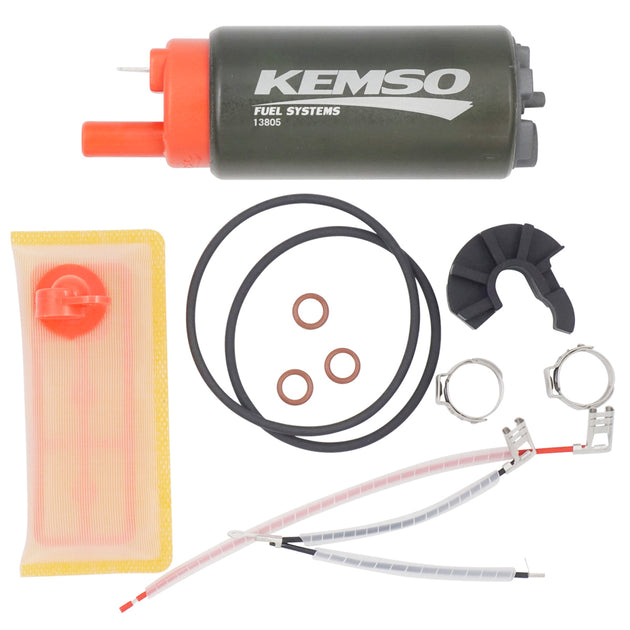 The value of risk control far exceeds the price of the component itself. The consequences caused by insufficient fuel supply include Knock (Knock Sensor value > 5V) or high exhaust temperature (> 950℃). Long-term operation will lead to piston melting damage, and the maintenance cost exceeds 3,000. Among the 217 modified vehicle fires recorded by the NHTSA in 2019, 315,500 vs. $250. Compliant selection must strictly follow the SAE J1681 alcohol fuel compatibility standard to avoid incidents similar to the recall of a certain brand in 2018 (leakage caused by swelling of the oil pump seal).
Economic decisions should be made in combination with the specific stage of modification. The basic stage upgrade (power increase of ≤15%) can be achieved through fine-tuning the original factory pump in combination with the FPR (fuel pressure regulator), with the cost controlled within 100. However, deep modification requires systematic matching: The 500HP solution demands a fuel pump flow rate of ≥600LPH (such as DW300C), combined with a 10mm fuel supply pipeline and a 40A independent relay, with a total budget of 400-800. Professional events such as Formula RIft require oil pumps to have redundant designs. A typical solution adopts dual parallel AEM50-1000 pumps (1200) to ensure that 80% of the flow rate is maintained even in the event of a single point of failure. Modification statistics show that 80% of vehicles with a power increase of over 35% must upgrade their fuel system in the first stage; otherwise, the actual efficiency conversion rate of other advanced kits (turbo /ECU) will decrease by 30% to 50%. Just as the well-known tuning workshop Vorshlag said: "The Fuel Pump is the artery of the engine. When the blood supply is insufficient, even the strongest heart will fail."
The value of risk control far exceeds the price of the component itself. The consequences caused by insufficient fuel supply include Knock (Knock Sensor value > 5V) or high exhaust temperature (> 950℃). Long-term operation will lead to piston melting damage, and the maintenance cost exceeds 3,000. Among the 217 modified vehicle fires recorded by the NHTSA in 2019, 315,500 vs. $250. Compliant selection must strictly follow the SAE J1681 alcohol fuel compatibility standard to avoid incidents similar to the recall of a certain brand in 2018 (leakage caused by swelling of the oil pump seal).
Economic decisions should be made in combination with the specific stage of modification. The basic stage upgrade (power increase of ≤15%) can be achieved through fine-tuning the original factory pump in combination with the FPR (fuel pressure regulator), with the cost controlled within 100. However, deep modification requires systematic matching: The 500HP solution demands a fuel pump flow rate of ≥600LPH (such as DW300C), combined with a 10mm fuel supply pipeline and a 40A independent relay, with a total budget of 400-800. Professional events such as Formula RIft require oil pumps to have redundant designs. A typical solution adopts dual parallel AEM50-1000 pumps (1200) to ensure that 80% of the flow rate is maintained even in the event of a single point of failure. Modification statistics show that 80% of vehicles with a power increase of over 35% must upgrade their fuel system in the first stage; otherwise, the actual efficiency conversion rate of other advanced kits (turbo /ECU) will decrease by 30% to 50%. Just as the well-known tuning workshop Vorshlag said: "The Fuel Pump is the artery of the engine. When the blood supply is insufficient, even the strongest heart will fail."
The value of risk control far exceeds the price of the component itself. The consequences caused by insufficient fuel supply include Knock (Knock Sensor value > 5V) or high exhaust temperature (> 950℃). Long-term operation will lead to piston melting damage, and the maintenance cost exceeds 3,000. Among the 217 modified vehicle fires recorded by the NHTSA in 2019, 315,500 vs. $250. Compliant selection must strictly follow the SAE J1681 alcohol fuel compatibility standard to avoid incidents similar to the recall of a certain brand in 2018 (leakage caused by swelling of the oil pump seal).
Economic decisions should be made in combination with the specific stage of modification. The basic stage upgrade (power increase of ≤15%) can be achieved through fine-tuning the original factory pump in combination with the FPR (fuel pressure regulator), with the cost controlled within 100. However, deep modification requires systematic matching: The 500HP solution demands a fuel pump flow rate of ≥600LPH (such as DW300C), combined with a 10mm fuel supply pipeline and a 40A independent relay, with a total budget of 400-800. Professional events such as Formula RIft require oil pumps to have redundant designs. A typical solution adopts dual parallel AEM50-1000 pumps (1200) to ensure that 80% of the flow rate is maintained even in the event of a single point of failure. Modification statistics show that 80% of vehicles with a power increase of over 35% must upgrade their fuel system in the first stage; otherwise, the actual efficiency conversion rate of other advanced kits (turbo /ECU) will decrease by 30% to 50%. Just as the well-known tuning workshop Vorshlag said: "The Fuel Pump is the artery of the engine. When the blood supply is insufficient, even the strongest heart will fail."